Month: August 2020

  • The blue days for Spirulina are over

    The blue days for Spirulina are over

    In search of new culinary experiences blue and green shades have been in a uprise in recent years and have experienced great success in the food industry. Since the approval by the United States FDA of spirulina in 2013 and the also by the European Union, Spirulina became the first natural blue available. Parallel with growth of the natural color market and with leading F&B companies pledging to switch to natural colors, the demand for the natural pure blue of spirulina took off.

    Spirulina is best known for its antioxidant properties, high nutrient content, and vibrant colors. Spirulina is a microscopic freshwater blue-green alga, grown and harvested in aquatic farms globally. Many associate spirulina with being green, whilst the less common blue variety is simply an extract of this blue-green algae that’s had its distinctive deep blue pigment extracted and isolated. The blue pigment is called phycocyanin and gives the gorgeous, almost cobalt blue color. Unlike regular spirulina which some say has a fishy taste, the blue version doesn’t but it still has all the same nutrients. Historically Spirulina was predominantly grown in Asia but after its FDA approval as a food colorant it has spirulina cultivation has expanded to Europe and the United States.

    Despite the recent surge in demand for Spirulina, the use of Spirulina is all but new. Its use can be traced back centuries as a food and nutritional staple of Aztecs in Mexico. After the 16th century the use of spirulina vanished from the historical records when, as part of the Spanish conquest the great lakes in the Valley of Mexico were drained. (Unlike the use of Carmine, also an Aztec originating color, that got its international boom after the conquistadors took it back to Europe.)

    According to Persistence Market Research the global market for spirulina is estimated to grow from $719 million in 2016 to $1,855.8 million in 2026, with an impressive CAGR (compound annual growth rate) of 10%. The prominence of spirulina in the supplement and growing natural color industries will continue to increase dramatically as consumers become more and more interested in natural products. It is clear that the blue days of spirulina are over.

    Spirulina color extract is primarily used in confectionery, yoghurts, ice cream, frozen desserts, dessert toppings, dry beverage, gelatin, puddings and custards. Spirulina color extracts are natural alternatives to replace synthetic coloring blends like e.g. Brilliant Blue.

    Interested in using Spirulina in your application? Contact us.

  • “What’s in a name..?”, Colouring foods v.s. food colouring

    “What’s in a name..?”, Colouring foods v.s. food colouring

    Food colours and colouring foods (also known as colouring foodstuff) are both used for the coloring of foods and have comparable sounding names. However, in European legislation, they vastly differ from each other. Food colours fall under the scope of the food additive regulation, whereas colouring foods do not. 

    The main criterion for the distinction between food additives and colouring foods is the degree of extraction. For example, when spinach extract is processed nonselectively and this extract is added to the product, it is not considered as a colour additive but as a food ingredient. However, when the spinach is selectively extracted for its chlorophyll (E140), then it is considered a food additive. Motivations for food and beverage manufactures for choosing either a Food colour or colouring food in the same color spectrum is often a combination of performance, marketing, costs and regulatory factors. It is important to clearly distinguish between a food ingredient and a food additive.

    In the general food law ((EC) No 178/2002) the basis for the assurance of a high level of protection of human health in relation to food is laid down. In this regulation, ‘food’ or ‘foodstuff’ is defined as:

    “Any substance or product, whether processed, partially processed or unprocessed, intended to be, or reasonably expected to be ingested by humans. ‘Food’ includes drink, chewing gum and any substance, including water, intentionally incorporated into the food during its manufacture, preparation or treatment.”

     The regulation on food additives controls which additives may be used as ingredients for the preparation of foods. The food additives are divided in several categories, according to their functionality, including food colours. Food colours are defined as:

    “Colours” are substances which add or restore colour in a food, and include natural constituents of foods and natural sources which are normally not consumed as foods as such and not normally used as characteristic ingredients of food. Preparations obtained from foods and other edible natural source materials obtained by physical and/or chemical extraction resulting in a selective extraction of the pigments relative to the nutritive or aromatic constituents are colours within the meaning of this Regulation.”

    The Regulation on food additives (EU No 1333/2008) makes no distinction between synthetically or naturally derived colour additives and therefore all these colours are labelled with an E-number. There are 40 approved food colour additives, labelled with E-numbers ranging from E100 to E180, of which 15 are of synthetic origin and 25 of natural of nature identical origin.

    A category that belonging to natural food colours are the “Colouring Foods” also known as “colouring foodstuff”. Colouring foods are defined by: ‘foods with colouring properties’ and are used by the food industry for over 30 years now. These foods are especially produced to impart colour to food with other foods. The quality and intensity of the colour is highly dependent of the quality of the raw materials. Currently, only fruits, vegetables and edible plants with high contents of pigments are used for the production of colouring foods. Examples of these colouring foods are orange carrots, pumpkins, black carrots, sweet potatoes, elderberries, blueberries, grapes, red cabbage, Spirulina, Hibiscus and Safflower.

    As mentioned earlier, colouring foods are referred to as food with colouring properties and are therefore “intended to be, or reasonably expected to be ingested by humans” and therefore, these colouring foods are considered as food.

  • Carmine, still “the King” of natural red colors.

    Carmine, still “the King” of natural red colors.

    Carmine has reigned the red zones of the color spectrum in food, beverage & cosmetics for many centuries. Carmine’s unique coloring characteristics made carmine a legendary red dye treasured by the ancient Mexicans and sold in the great Aztec marketplaces, where it attracted the attention of the Spanish conquistadors in the sixteenth century. Shipped to Europe, the dye created a sensation, producing the brightest, strongest red the world had ever seen. Carmine became one of the world’s most precious commodities after gold and silver. Spain’s cochineal monopoly was worth a fortune, this luminous luxury was a source of war and intrigue. But in Europe, few fully understood the nature of carmine. Was it made from plant or animal? Could it be stolen from Mexico and transplanted to their colonies? The quest to crack the cochineal enigma and break Spain’s monopoly lasted three hundred years.

    Nowadays despite continuous attempts to knock carmine of its throne, there is still no natural color that matches the unique combined characteristics of carmine. Currently Europe takes the highest share of carmine launches in food and drink launches with a red coloring ingredient. 64% of European food and drink launches that contain a type of red color contain carmine. The majority of the worlds’ carmine production now takes place in Peru.

    For those interested in learning more about the history of Carmine the book from Amy Butler “A perfect Red” comes highly recommended.

    For over 37 years BioconColors has been one of the world’s leading carmine producers. Are you interested in using Carmine in your application? Contact us

  • Black further gaining strength as food coloring trend

    Black further gaining strength as food coloring trend

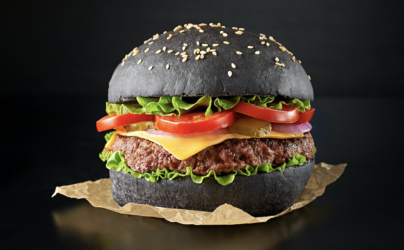
    Black-colored food is popping up all over. From black coconut-ash ice cream to activated-charcoal-enhanced smoothies to black brioche buns. With Japan often being on the forefront of colorful food and drink trends, it is not supricing to see Japanese Burger King developed the Kuro Burger with a bun colored with bamboo charcoal and squid ink sauce and black-colored cheese. Ikea in Japan even introduced a black “Ninja Dog”, a hot dog that’s entirely black, from sausage to bun.

    Black as food color is not new, for example, squid ink has been used to flavor and color pasta and risotto for a long time. Black barley, quinoa and garlic add eye appeal and drama to classic dishes. The more dominant black natural colorant is vegetable carbon. Vegetable Carbon (Carbon black) is made from fine particles of carbonized vegetable material, obtained through steam activation of vegetable fibres. Consumers often associate black with a bitter flavor, just the color seems to make the flavor more intense even if no flavor is added.

    Vegatable carbon is suitable for black food coloring  in e.g. confectionery, bakery products, decorations, cheese coating, black caviar substitute, cosmetics, and pharmaceuticals.

    Contact us to learn more about food coloring with Vegetable Carbon.